
Charity Merchandise vs. Direct Donation: How to Give Well

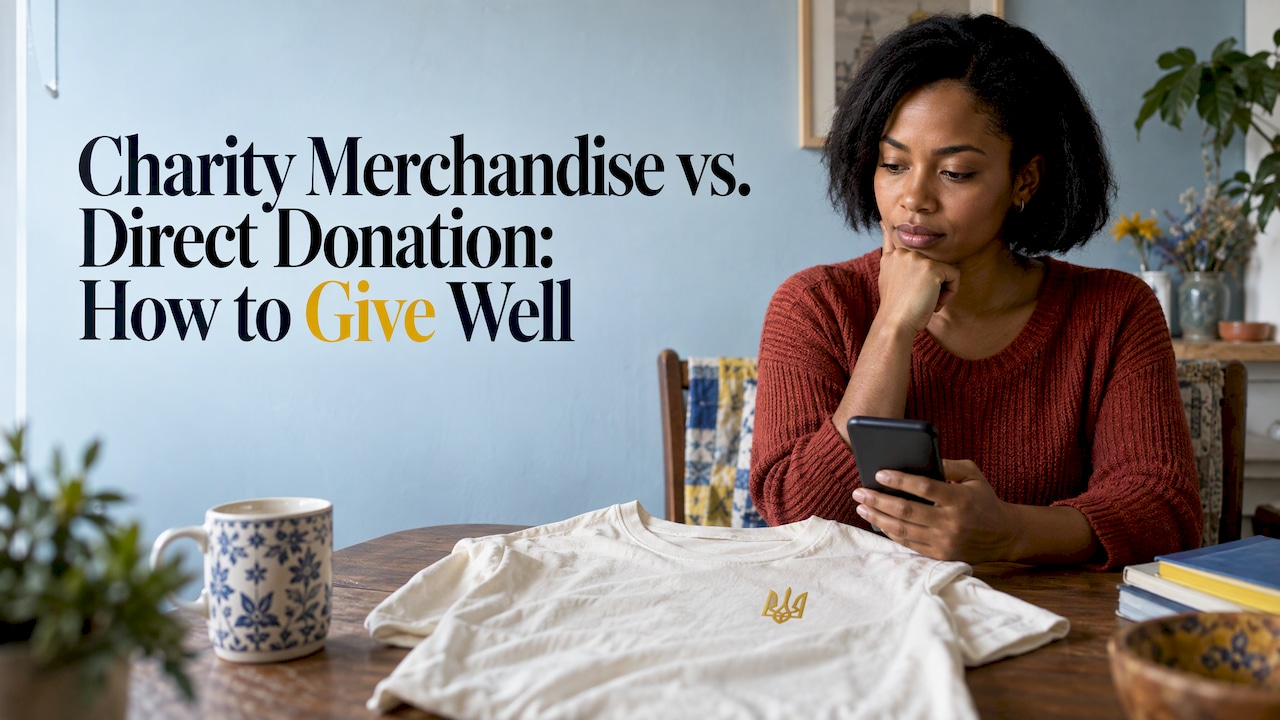
A direct donation sends money to a charity. Charity merchandise gives you something to wear, carry or give away, and a share of the seller’s profit goes to a cause. For Ukraine, the strongest approach is to buy from a seller that is open about who designs the products and which charities receive the money. You then get a lasting item and a contribution in one purchase. At We Ukraine, products come from local Ukrainian designers, a portion of profits goes to Ukrainian charities, and shipping is free worldwide.
The two options are not rivals. They answer different needs. This guide explains how the money moves in each case, what an item adds, and how to check any seller’s claims before you pay.
TL;DR
A donation is a straight gift to a charity. A merchandise purchase is a sale in which a share of profit supports a cause, and you also receive a product.
Merchandise suits supporters who want a visible, lasting way to show solidarity, and gift buyers who want the gift to carry meaning.
Whatever you choose, read exactly what the seller says it donates: a share of profit, a share of price, or a fixed amount, and to whom.
Check that the receiving charity is registered, and look for reports on how funds were raised and spent.
We Ukraine works with local Ukrainian designers, donates a portion of profits to trustworthy Ukrainian charities and ships free worldwide.
Table of Contents
How a direct donation works
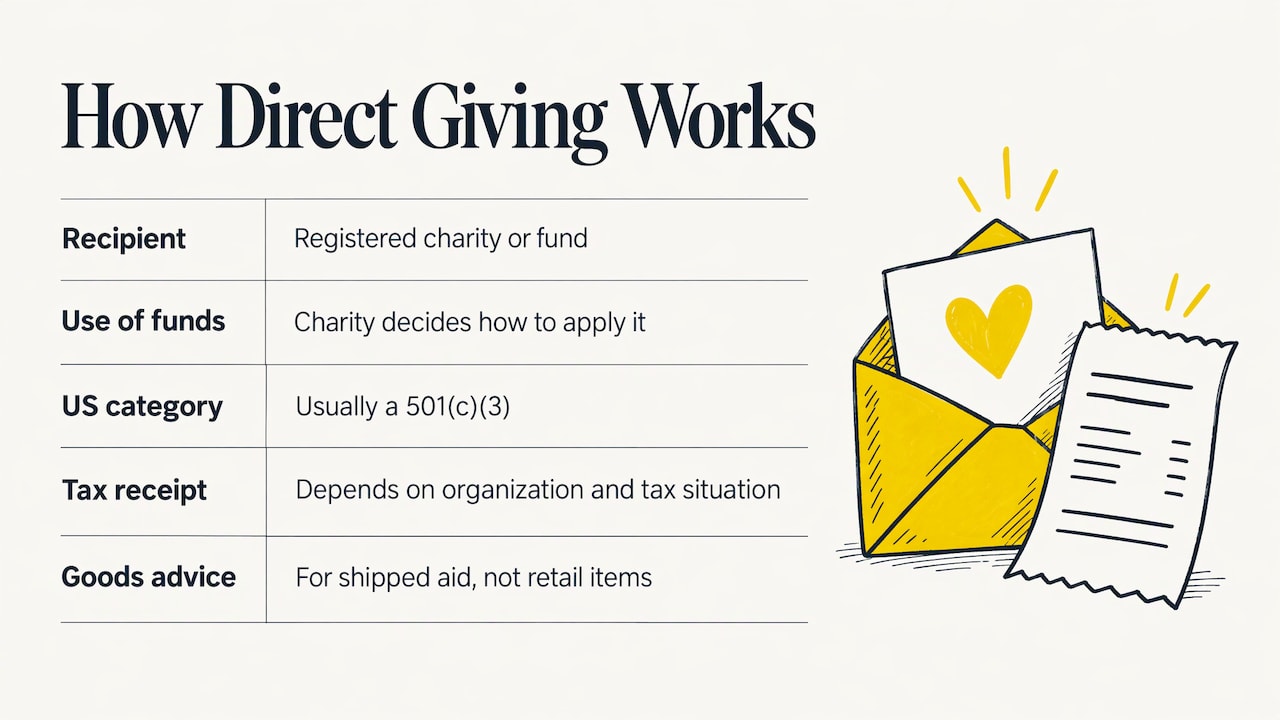
When you give directly, your payment goes to a registered charity or fund, and the charity decides how to apply it. In the US, that usually means a 501©(3), the tax category for most charities. You may also get a receipt for tax purposes, depending on the organization and your own tax situation.
Direct giving is simple and fast. It is also abstract: you send money and receive an email. There is no object, no design, nothing to wear or pass on. For many people that is fine. For others, especially people who want to keep a cause visible in daily life, it feels incomplete.
One point of confusion is worth clearing up. Officials and aid specialists often tell people to give cash rather than goods. The House of Commons Library notes that the UK Government and the Polish Embassy recommend cash donations to registered charities over goods, because unsolicited goods can obstruct supply chains. Charity Intelligence Canada makes a similar point about sending supplies. That advice is about shipping physical aid items, such as clothes, food or medicine, to the region. Buying a retail product from a store is a different thing: nothing is sent to a warehouse or border crossing, and the product never enters the aid supply chain.
How charity merchandise works
Charity merchandise is a retail sale. You pay for an item, the seller covers its costs, and the seller commits to giving part of what is left, or part of the price, to a charity. Because the arrangement is a sale, the terms are set by the seller. That is why wording matters.
Common models include:
A share of net profit. The seller subtracts its costs, then donates a portion of what remains.
A share of the sale price. A fixed percentage of each order goes to the cause.
A fixed amount per item. A set sum per product sold.
We Ukraine donates a portion of profits to trustworthy Ukrainian charities. The reason this model exists is simple: a product keeps working after the checkout page closes. A shopper bag goes to the market every week. A mug sits on a desk. A cap starts conversations. Each of those items carries a Ukrainian symbol or message to people who might never have read a fundraising appeal.
A worked example with illustrative numbers
These figures are invented to show the mechanics, not to describe any seller’s actual terms. Suppose an item sells for $30 and costs $18 to make, pack and ship, leaving $12 in profit. If the seller donates a quarter of that profit, $3 goes to the charity. The same $30 sent as a direct donation would put the full $30 at the charity’s disposal, minus whatever the charity spends on its own operations.
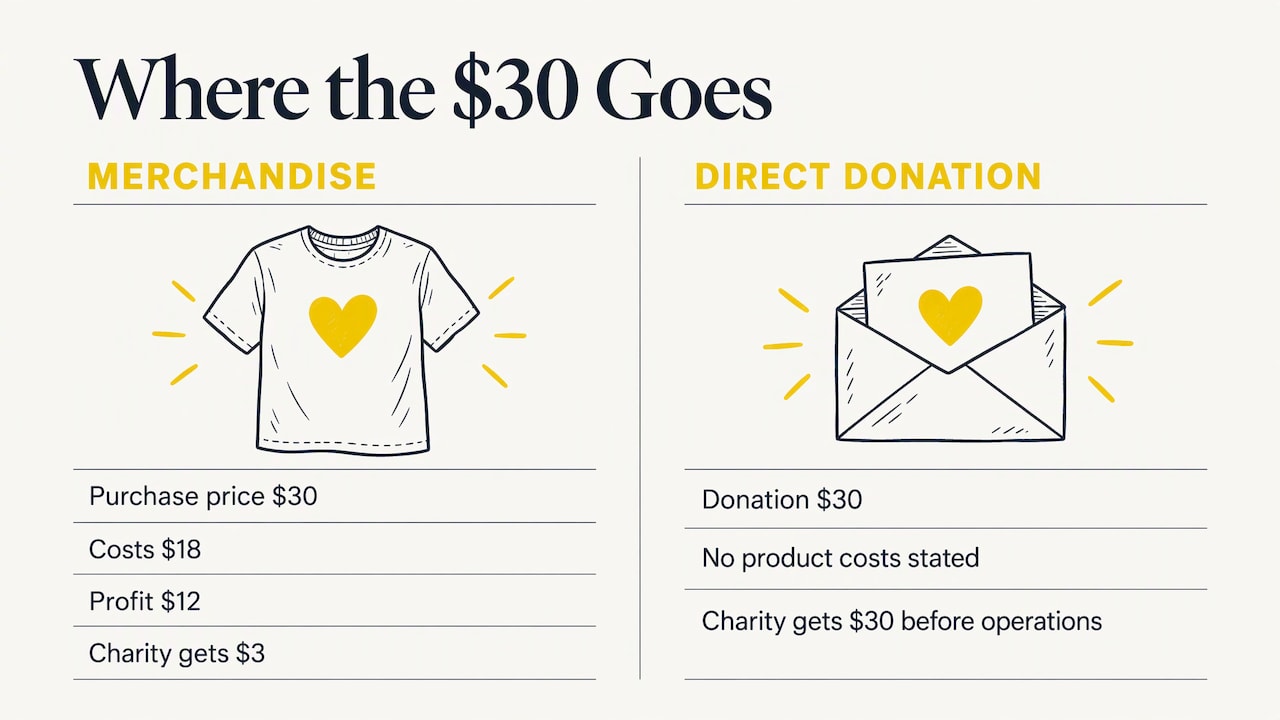
The comparison matters less than the question behind it: what do you want the $30 to do? If you want only the largest transfer, give directly. If you also want a designed item for yourself or someone else, a purchase covers both goals in one order, and many supporters do exactly that: buy the item, and give directly on top.
What an item adds that a donation does not
A donation is invisible. A product is not, and that changes what you can do with it.
It makes support visible
A t-shirt, cap or tote with a Ukrainian symbol shows solidarity in public. People ask what it means, and you get to tell them. That keeps attention on Ukraine long after news cycles move on.
It carries culture
Many supporters want more than a slogan. They want designs that draw on real Ukrainian symbols and messages. We Ukraine creates its products in partnership with local Ukrainian designers, and its designs focus on real Ukrainian symbols rather than generic graphics. The Palyanytsya t-shirt, named for a traditional Ukrainian bread, shows how a single design can carry a piece of everyday Ukrainian culture.
It solves the gift problem
Telling a friend “I donated in your name” is a lovely gesture, but it leaves them with nothing in hand. A gift that carries a cause gives the recipient something to use and a reason behind it. If you are shopping for someone, our guide to ethical gifts that support Ukraine walks through how to choose.
It reaches people who would never click a donate button
Some people will not respond to an appeal but will happily buy a well-made mug. A purchase draws them into a cause on their own terms.
When merchandise is the better fit
Merchandise suits you if:
You want a lasting reminder of your support, not just a receipt.
You are buying a gift for someone who would value the meaning behind it.
You like Ukrainian design and want products made with Ukrainian designers.
You want to support the cause as part of ordinary shopping, such as a bag you would buy anyway.
You are building up to a bigger gift later and want to start with something regular and low-effort.
A direct donation suits you if your sole goal is to send a specific sum to a specific organization, for instance a charity you already know and follow. Many supporters combine both: a purchase for the item and a separate gift for the organization they trust most.
For a wider look at your options, see supporting Ukraine through shopping and donating through purchases. If you would like to understand how aid itself reaches people, our piece on humanitarian aid donations covers it.
What the money is actually promised to
The most useful habit for any cause purchase is to read what the seller commits to. Consumer finance journalists at MoneySavingExpert point out in their charity gifts guide that whether a purchase funds the exact item you picked depends on the charity, and that some charities may put the money toward a related area or wherever it is most needed. That guide covers UK charities, but the habit applies anywhere: find out whether the promise is tied to one item, one project or the cause in general.
For merchandise, read the product or about page for these points:
What is donated: a portion of profit, a portion of price, or a fixed sum.
Who receives it: named charities or a vague “good causes”.
Where the products come from: who designs them, and whether the story is specific.
How the seller describes its giving: plain statements, not hints.
We Ukraine states that it donates a portion of profits to trustworthy charities helping people affected by the conflict, and its about page tells the story of who is behind the shop.
How to check a seller’s donation claims
A good seller is glad to be read closely. These are the checks worth making, in order.
Confirm the charity is registered
For a US charity, look it up in the IRS database of tax-exempt organizations, which lists organizations eligible to receive deductible donations. Outside the US, use the national register. The House of Commons Library points out that a UK charity’s registration can be verified with the Charity Commission for England and Wales, OSCR in Scotland or the Charity Commission for Northern Ireland.
Look for reporting
Charity Intelligence Canada says donors should expect charities to report how much was raised, when it was spent, what it was spent on and who it helped. A charity that publishes this is easier to trust. For example, Nova Ukraine states on its FAQ page that it is a US 501©(3) and gives its EIN, the tax ID number you can use for a lookup.
Watch the wording of appeals
The same guidance warns about appeals that lean on “long term rebuilding” or “development” language when what Ukraine needs most is humanitarian aid now. If a seller’s wording is unclear about what its donations do, read further before buying.
Check the story of the products
Real designs have real origins. Ask: who made this, and where does the design come from? Our buying guide for Ukraine merchandise and the guide to choosing support merchandise go through this in more detail, and our checklist for choosing a charity applies to any cause.
Use the same discipline for every kind of giving
These checks apply to direct donations too. Whether you give through a donation page or a shop, you are entitled to know who receives the money and how they report.
A note for groups and organizers
If you coordinate a club, school or volunteer team and want to run a shared effort, the practical side matters as much as the cause. Planning how your volunteers will communicate and register is covered well in this guide to choosing tools volunteers use. Individual members can then buy items for themselves while the group decides on any collective gift.
Where to start with We Ukraine
We Ukraine is an online store for Ukrainian-inspired apparel, hats, mugs, bags, gifts and accessories. Products are designed with local Ukrainian designers, a portion of profits goes to trustworthy Ukrainian charities, and shipping is free worldwide.
Pick by what you will actually use:
Everyday wear: t-shirts and apparel with Ukrainian motifs.
Headwear: caps, bucket hats and beanies, including the Tryzub beanie.
Daily carry: tote bags and shoppers.
Desk and kitchen: mugs and bottles, such as the Peace enamel mug.
Presents: gifts and accessories.

Browse the full range in the We Ukraine online store.
Our perspective
We started We Ukraine because many people told us the same thing: they wanted to do something for Ukraine that lasted longer than a single click. A donation matters, and many of our customers give directly as well. But a person who wears a Ukrainian design, carries it to work or gives it to a friend keeps the conversation going. That is why we work only with local Ukrainian designers and build our products around real Ukrainian symbols and messages. We do not want generic graphics. We want each item to mean something to the person who buys it and to the person who sees it. We donate a portion of profits to trustworthy Ukrainian charities, and we ship free worldwide so that a supporter anywhere can take part. Our view is simple: a purchase can be a real act of support, and the best purchases are the ones where you know what you are buying and why. Dmytro
FAQ
Is buying merchandise a good way to support Ukraine?
Yes, when the seller states what it donates and to whom. A purchase gives you a product and sends a portion of profits to charities. Read the seller’s wording first, as the checklist above explains.
Can I do both: buy merchandise and donate directly?
Yes, and many supporters do. The purchase gives you something lasting and a contribution through the seller’s giving, while a separate gift to a charity you follow lets you choose the organization and amount yourself.
Is a merchandise purchase tax deductible?
Generally not in the way a direct gift to a charity can be, because part of what you pay is the price of the item. In the UK, for example, the purchase element of goods is not eligible for Gift Aid. For your own situation, ask a tax adviser.
Does the advice to give cash instead of goods apply to buying merchandise?
No. That advice, such as the recommendation from the UK Government and Polish Embassy, concerns sending physical aid items to the region. Buying a retail product in a shop does not send anything into the aid supply chain.
What should I look for before buying?
Look for a clear statement of what is donated, named charities that you can look up in a registry, products with a real design story, and plain language about how the seller gives.
Sources
Recommended
Comments